
 简体中文
简体中文 English
Client Background
The client is a domestic mid-sized automotive parts manufacturer specializing in exterior components such as PP/ABS plastic bumpers, grilles, and decorative covers, while also handling small-batch painting processes for aluminum alloy wheels. The production line utilizes a combination of a fixed tunnel curing oven and mobile infrared curing lamps at specific workstations; these are used for full-line curing of high-volume parts and for localized touch-ups or curing of test-sprayed components, respectively.
The original process relied primarily on hot-air circulation ovens supplemented by standard infrared lamps for localized heating. Issues included thermal deformation of plastic substrates, asynchronous drying between the paint film surface and the underlying layer, and significant fluctuations in batch yield. Furthermore, the production cycle time was constrained by the drying process—failing to meet delivery schedules for new orders—while energy consumption remained high.
Core Process Pain Points
1. Flaws in thermal mechanism: Traditional hot-air convection heats the air before transferring heat to the workpiece, resulting in slow temperature rise. Uneven thermal gradients cause plastic parts (especially thin-walled bumper sections) to warp or deform. Paint films suffer from "surface drying while the base remains wet," leading to defects such as pinholes, blistering, and poor adhesion.
2. Poor light source consistency: Standard infrared lamps sourced from third parties exhibited spectral shifts and high power variance within the same batch. This resulted in uneven irradiation inside the curing oven, inconsistent curing levels across the batch, and significant yield fluctuations between batches.
3. Incompatible equipment components: Heating tubes inside the tunnel oven and lamps for the mobile curing units had different specifications. This necessitated a wide variety of spare parts, complicated inventory management, and made on-site replacement and maintenance time-consuming.
4. Response characteristics mismatched with production line: Traditional heating elements required long preheating times, making them incompatible with intermittent loading schedules. Continuous energy consumption during standby mode resulted in high electricity usage per workpiece.
5. Lack of spectral matching validation data: The absence of spectral analysis reports for specific paint coatings meant that process tuning relied on repeated test spraying, resulting in lengthy debugging cycles.
Our Comprehensive Solution
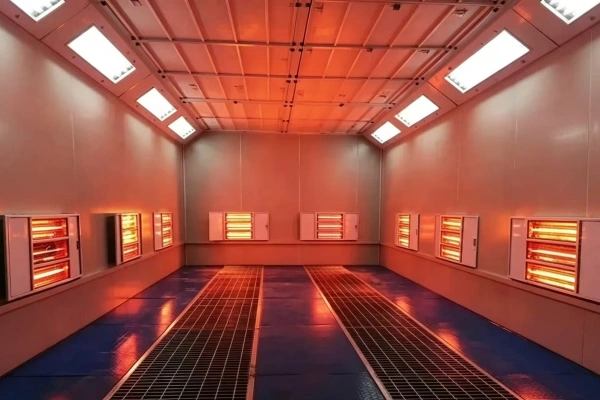
We provide a solution based on fast-to-medium wave halogen infrared heating tube systems tailored for the painting and curing of automotive plastic parts. This solution covers both the internal modules of the tunnel curing oven and the mobile curing lamps used at individual workstations. 1. Spectral-Specific Selection
Fast-response medium-wave infrared (MWIR) heating tubes (1.4–2.2 μm spectral range) are selected. This wavelength range aligns closely with the absorption spectra of automotive basecoats and clearcoats, allowing radiant energy to act directly on the paint film; this minimizes indirect heat transfer to the plastic substrate and reduces the risk of thermal deformation in the workpiece.
2. Optical System Configuration
The tubes feature a semi-reflective white quartz coating and are paired with high-precision aluminum alloy reflectors. The tunnel oven utilizes a modular matrix arrangement; irradiation simulations based on bumper curvature are conducted to optimize tube spacing and installation height. Mobile curing lamps employ a multi-tube modular layout to ensure uniform irradiation across localized repair areas.
3. Component Standardization
Both tunnel curing ovens and mobile curing lamps use the same series of heating tubes, enabling spare part interchangeability. Strict controls limit individual tube power tolerance to within ±5%, and batch-wide spectral consistency testing eliminates curing variations caused by light source inconsistencies.
4. Thermal Adaptation to Production Line Pace
Heating tubes enable millisecond-level rapid startup and shutdown, synchronizing with the production line to eliminate the need for prolonged preheating. The system adapts to intermittent loading modes, reducing energy consumption during idle periods. High-temperature ceramic sockets and molybdenum electrode assemblies ensure stable, long-term operation within the high-temperature environment of the curing oven.
5. Technical Documentation for Process Commissioning
Spectral test reports and power inspection reports are provided with the shipment to assist customers in calibrating process parameters and shortening the curing process commissioning cycle. Module assembly drawings are also supplied to facilitate equipment maintenance and modification.
Quantified Business & Process Results (Focusing on technical process metrics; suitable for technical manuals, tender documentation, and in-depth case studies on the official website)
1. Improvement in Process Yield
The defect rate for plastic bumper warping and deformation dropped from 9.2% to 1.7%. Defect rates related to paint film blistering, pinholes, and adhesion failures fell from 11.5% to 2.6%, resulting in a 16.4 percentage point increase in the overall qualified product yield. 2. Production Cycle Time Improvement
Effective paint film curing time was reduced from 16–20 minutes (hot-air process) to 7–9 minutes; hourly throughput for the tunnel line increased by 75%; curing time for localized spot repairs using mobile curing lamps dropped by 60%, significantly boosting workstation throughput efficiency.
3. Energy Consumption Optimization
Eliminated the need for prolonged preheating of the entire unit, resulting in a 41% reduction in comprehensive electricity consumption per workpiece; eliminated energy loss from continuous heating during idle periods, thereby reducing the load on workshop transformers.
4. O&M Cost Optimization
Standardized spare parts between the tunnel curing oven and mobile curing lamps, reducing the number of spare part SKUs by 50%; extended the effective service life of lamp tubes, leading to a 44% drop in annual spare part procurement costs and significantly reducing downtime for replacements.
5. Process Stability
Tightened control over light source power and spectral consistency across batches; improved curing uniformity for workpieces within the same batch and drastically reduced process fluctuations between batches; utilized spectral reports to assist in parameter adjustment, shortening the commissioning cycle for new processes by 55%.
Streamlined Technical Data Sheet (Professional Section of Product Detail Page)
Application Scenario: Automotive plastic components | Tunnel curing oven + Mobile infrared curing lamp at the workstation
Pain Points: Hot-air drying caused plastic part deformation, uneven paint film curing, yield fluctuations between batches, and high energy consumption.
Solution: Fast-to-medium wave infrared heating tubes + semi-white coated reflector modules; spectral output matched to automotive paint coatings for direct radiant heating of the paint film; interchangeable lamp tubes between the tunnel oven and mobile equipment; spectral inspection reports included.
Significant drop in overall defect rate;
75% increase in production capacity;
41% reduction in energy consumption per unit;
Simplified spare part SKUs and shortened process commissioning cycle.
