
 简体中文
简体中文 English
I. Client Overview
The client is a specialized facility for the spray coating of hardware and metal products, primarily engaged in the electrostatic powder coating and liquid painting/curing of sheet metal chassis, hardware accessories, and metal housings. Equipped with multiple continuous mesh-belt tunnel drying ovens and operating 24-hour mass-production assembly lines, the company is a typical coating enterprise characterized by high energy consumption, high production capacity, and stringent quality control requirements.
The existing drying system utilized a traditional hot-air circulation heating method. It suffered from common industry issues such as slow heating, high energy consumption, uneven drying (resulting in inconsistent finish quality), high defect rates, and production bottlenecks. Unable to meet the quality and delivery efficiency standards required for high-end orders, the company urgently needed a comprehensive upgrade of its heating system.
II. Pain Points of the Existing Production Process
1. Extremely low heating efficiency and severe production bottlenecks
Traditional hot-air ovens require heating the air inside the chamber before transferring heat to the workpieces. This process is time-consuming, limits the speed of the assembly line, prevents production scaling during peak seasons, and results in low equipment utilization.
2. Uneven coating curing and high defect rates
Hot-air convection heating creates temperature disparities and "dead zones." Workpieces often exhibit issues such as edges drying completely while the center remains damp, or incomplete powder curing in certain areas. This leads to subsequent problems like coating peeling, blistering, flaking, and color inconsistency, resulting in a high volume of rework.
3. Persistently high energy costs
Continuous heating of the entire oven chamber and significant heat loss through the oven body—combined with fans running under high load 24 hours a day—result in electricity costs accounting for a disproportionately large share of total production expenses, continuously squeezing profit margins.
4. Dust adhesion and poor coating surface cleanliness
Strong hot-air convection causes airborne dust within the oven to circulate and adhere to the wet coating surface, creating particulate defects and making it difficult to meet yield standards for high-end orders.
5. Cumbersome equipment maintenance
Traditional heating components suffer from rapid wear and high failure rates. Frequent downtime for repairs and maintenance disrupts the rhythm of continuous production. III. Customized Solutions
IV.
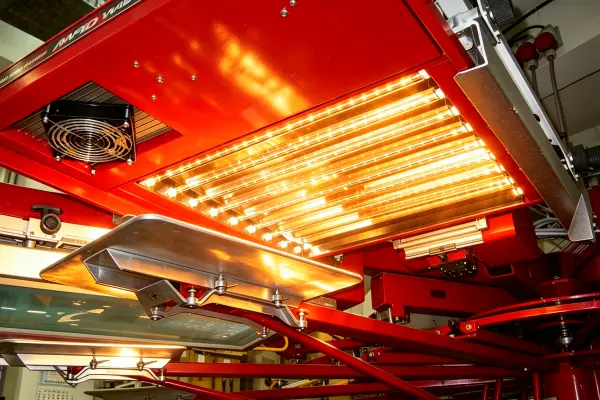
To address the specific process requirements of powder coating and liquid painting curing for hardware, we offer a comprehensive replacement solution using fast-response medium-wave, twin-tube infrared heating modules (with semi-white or semi-gold reflectors). These modules are designed to fit existing tunnel oven structures, allowing for a direct upgrade without requiring major equipment modifications:
1. Replaces traditional hot-air heating with direct infrared radiation technology
Infrared rays pass directly through the air to focus radiation on the coating film, heating the workpiece and the paint surface directly rather than the air. This fundamentally resolves issues associated with hot-air heating, such as thermal lag and high heat loss.
2. Twin-tube module array for enhanced temperature uniformity
High-power twin-tube infrared heating modules provide higher power density within the same installation footprint. This eliminates temperature "dead zones" associated with single-tube heating, ensuring highly balanced temperatures across both the transverse and longitudinal axes of the tunnel oven—ideal for curing large-format hardware workpieces.
3. Directional heat-focusing structure (semi-white coating) for heat retention and energy savings
The lamps feature an integrated reflective layer that redirects otherwise wasted heat toward the workpiece heating zone. This significantly reduces heat absorption losses by the oven structure and greatly improves thermal efficiency.
4. Segmented and zoned precision temperature control
Temperature is controlled independently across zones to match the assembly line stages: feeding, preheating, curing, and cooling. The front section enables rapid surface drying to prevent dust contamination, while the rear section maintains a constant temperature for thorough curing, perfectly accommodating both liquid painting and powder coating processes.
5. Modular installation with independently replaceable tubes
Standardized module design ensures simple wiring and fewer potential points of failure. Maintenance does not require dismantling the entire assembly, significantly reducing both maintenance time and costs.
IV. Quantifiable Business Results (Real-world Commercial Data)
1. Significantly improved heating efficiency and expanded production capacity
The total heat-up time for the tunnel oven is reduced from the original 8 minutes to under 3 minutes. Conveyor line speeds can be stably increased by over 25%, directly boosting daily processing capacity. This allows for the easy handling of excess orders during peak seasons and effectively eliminates production bottlenecks. 2. Comprehensive upgrade in paint film quality and significant improvement in yield rates
The paint finish cures uniformly, eliminating issues such as blistering, peeling, color inconsistency, and incomplete curing. The first-pass yield rate has increased by over 9%, rework volume has dropped by 70%, and the delivery pass rate for high-end orders has reached 100%.
3. Elimination of dust defects and improved surface smoothness
By eliminating high-velocity hot air convection drying, the air inside the oven remains stable and dust-free. Particle defects on the paint surface are thoroughly resolved, and the product's visual quality is significantly enhanced, meeting the standards for high-end hardware coating orders.
4. Significant energy savings and reduced production costs
Infrared directional radiant heating eliminates the need to continuously heat the entire volume of air within the oven. Combined with a heat-reflecting structure, the entire drying system achieves an overall electricity saving of 20%–28%, drastically cutting monthly and annual electricity costs and significantly boosting profitability.
5. Enhanced equipment stability and reduced O&M costs
The infrared lamps feature a long service life and vibration resistance, making them suitable for 24-hour continuous production and significantly reducing downtime caused by malfunctions. An independent lamp replacement design cuts subsequent maintenance labor hours and spare parts costs by over 40%.
6. Optimized production environment
Reduced heat emission from the oven body lowers the overall workshop temperature, creating a more comfortable working environment while simultaneously reducing the energy required for workshop cooling.
V. Solution Summary
Addressing the key challenges of the hardware coating industry—such as the need for high-volume continuous production, stringent quality requirements, and high energy costs—this solution replaces traditional hot air drying with infrared dual-tube heating modules. It delivers four core benefits: increased speed, improved quality, energy savings, and operational ease. It represents the optimal, mature solution for energy-saving and efficiency-enhancing retrofits of hardware coating tunnel ovens, suitable for curing applications across a full range of products, including sheet metal, equipment housings, aluminum parts, and hardware accessories.
